
Beyond the Scale: Protecting Data Quality in Cancer Cachexia Trials
A weight measurement takes seconds. Understanding what it means in a cancer cachexia trial requires a much longer view: the patient’s recent clinical history, treatment exposure, appetite, physical function and the circumstances of each assessment. For sponsors and research teams, this creates an operational challenge with scientific consequences. Every visit must preserve enough context to make changes over time interpretable, while remaining manageable for people receiving cancer treatment.
Cachexia research illustrates how closely clinical operations and scientific interpretation are connected. Measurement procedures, questionnaire completion and follow-up arrangements deserve attention from the earliest stages of study planning.
Different outcomes tell different stories
The international consensus on cancer cachexia describes a syndrome involving ongoing muscle loss, with or without fat loss, and progressive functional impairment. Its assessment extends across food intake, muscle mass, strength and other clinical dimensions. These measures capture related but distinct aspects of a patient’s condition. Fearon et al., 2011
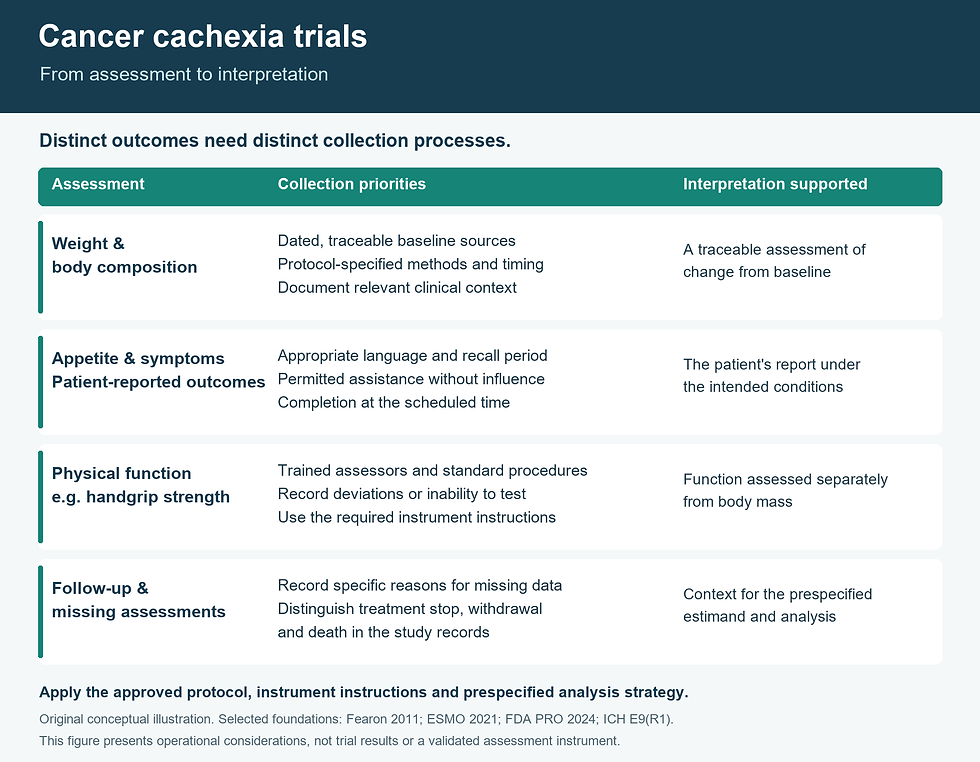
The ROMANA 1 and ROMANA 2 randomised trials provide a useful example. In patients with advanced non-small-cell lung cancer and cachexia, anamorelin increased lean body mass compared with placebo, while neither trial demonstrated a statistically significant between-group improvement in handgrip strength. The findings illustrate why body composition and physical function require separate assessment and interpretation. Temel et al., 2016
For study teams, the practical implication is clear: each endpoint needs its own reliable collection process. Consistency in one measurement cannot compensate for incomplete or inconsistent collection of another.
Establish a baseline that can support comparison
Baseline preparation begins before the first scheduled assessment. Where eligibility depends on previous weight loss, teams need to understand which historical measurements are acceptable, their dates and sources, and how the protocol requires changes to be calculated.
ESMO’s cachexia guidance recommends assessment across weight history, food intake, body composition, performance status and other relevant clinical factors. This broader clinical picture helps explain why a single number offers limited context. Arends et al., 2021
Operationally, sites should translate the protocol into clear responsibilities: who obtains each measurement, which equipment or method is required, where the source record is retained and how discrepancies are resolved. Training should include practical examples of ambiguous historical records and incomplete assessments.
The aim is a traceable baseline that supports the comparisons the study intends to make.
Protect the patient’s voice
Appetite, symptoms and physical limitations may change between visits. Patient-reported outcomes can capture experiences that routine clinical records do not describe in sufficient detail.
The FDA’s oncology guidance addresses the selection and collection of patient-reported outcomes within cancer trials. Although it is not specific to cachexia, it provides a relevant framework for planning these assessments. FDA, 2024
At site level, that planning becomes very practical. Participants need understandable instructions, the appropriate language version and clarity about the period each question covers. Staff need to know what assistance is permitted without interpreting the questions or influencing answers.
Collection timing also needs attention. Where the protocol specifies an assessment before other procedures or discussions, the visit workflow should make that sequence achievable. A questionnaire completed outside its intended conditions may remain readable while becoming harder to interpret.
Understand why data are missing
In advanced cancer studies, a missed assessment may reflect illness, hospitalisation, logistical difficulty, treatment discontinuation or a participant’s decision. These circumstances carry different information.
ICH E9(R1) distinguishes events affecting interpretation of the treatment effect from missing observations. It also highlights the importance of collecting information needed for the study’s predefined research question. ICH E9(R1)
For operations teams, this means recording specific reasons when an assessment is unavailable and distinguishing treatment discontinuation from withdrawal from study follow-up. Death requires the prespecified analytical approach; it cannot simply be treated as an ordinary missed visit.
Follow-up must remain consistent with the protocol, consent and participant preferences. Accurate documentation helps statisticians assess the evidence without asking site teams to make analytical decisions themselves.
Make the research fit the care pathway
A workable cachexia study connects oncology care, nutritional assessment and research activities. Before activation, teams should map the participant’s visit: appointments, assessments, questionnaires, staff handovers and any protocol-required body composition or functional testing.
That exercise can reveal avoidable duplication, unclear ownership and unrealistic scheduling. Patient and site input can help identify these problems early, consistent with the emphasis on proportionate procedures and participant burden in ICH E6(R3). ICH E6(R3)
During delivery, review should look for patterns: repeated questionnaire omissions, inconsistent assessment timing or recurring documentation gaps. Early discussion with sites can clarify whether the issue involves training, workflow or an unresolved protocol question.
Good clinical operations give each endpoint a dependable path from the participant to the dataset. In cachexia research, that discipline helps preserve the distinction between changes in body composition, symptoms and function.


Comments